Hi, me again. Gwei.
Last post was about installation. A few people wrote back: it's up, so what now? Do I just leave it alone?
Honestly, aluminum pergolas are the low-maintenance kind. No sanding and oiling every year like timber, and nothing rusts through. Low-maintenance is not no-maintenance, though. Going through our service tickets over the years, hardly any are about the material failing. Almost all of them are a gutter
nobody touched in a year, the wrong tool used once, or blades that sat at the same angle all winter.
|
One customer in Australia sticks with me. He hired cleaners at the end of the year, and they hit the roof with a pressure washer from twenty centimeters away. It looked spotless. A month later the louvers stopped moving. We opened it up: the water had pushed the seal out of the junction box and the motor was full of water. A new motor isn't expensive. Taking the roof apart is. |
So this post is about maintenance. All of it comes out of service tickets, not out of the manual.
Twice a year, done properly, is enough: once in spring, once before winter. In between, if there has been a heavy storm, a strong wind, or leaves piling up for days, take a look. You really don't need to be up a ladder every month.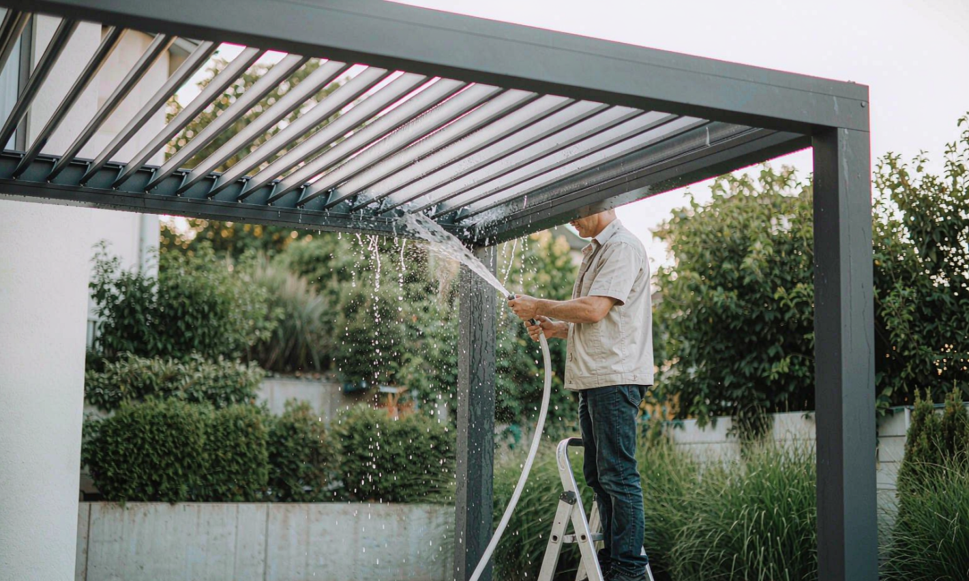
The surface is polyester powder coating, normally 60 to 80 microns thick. It is harder than paint, but two things will ruin it: scraping, and strong acids or alkalis.
The list of things that work is short: warm water, mild dish soap (two squirts in a bucket is plenty), a soft cloth or sponge, and a long-handled soft brush. Rinse with a garden hose, no pressure.
Always rinse again with clean water at the end. Soap left in the seams dries into a film that attracts even more dust.
These next ones I have actually watched people use:
Table 1 Cleaning methods that damage a pergola
|
Don't use |
What happens |
|
Pressure washer up close |
Blows out sealant and junction-box gaskets; water gets into the motor and the column cavity |
|
Steel wool, scouring pads, metal scrapers |
Cuts through the coating to bare aluminum; peeling starts right there |
|
Toilet cleaner, tile cleaner, chlorine bleach |
The coating turns chalky and dull, and it does not come back |
|
Acidic silicone to patch the seams |
Acetic acid attacks the aluminum. You make it worse |
|
WD-40 sprayed into the louver pivots |
Smooth for two months, then it gums up with dust and the blades stick |
Bird droppings and tree sap need their own paragraph. Both are acidic; wipe them off when you see them, don't wait for the seasonal round. If the pergola sits under trees, expect to do it every two weeks from April to June. One customer scrubbed dried droppings with steel wool. That whole section of coating peeled off the next year, and the only fix was replacing that beam.
Wiping it down is the easy part. These four decide how many years you get out of it.
Drainage channels and gutters.This is the number one item on service tickets. Leaves, pollen and catkins pack into the channel, a heavy rain can't get through, and the water runs down the inside of the column or spills over the end and soaks the base plate.
Bolts and connectors.Thermal expansion plus wind vibration loosens a few of them every year. Run a socket over them in a diagonal pattern. Don't go at it with an impact driver; stripped threads in aluminum are a much bigger problem than a loose bolt. While you're there, check the joints for white powder. That means galvanic corrosion where dissimilar metals meet, and the washers need replacing.|
Louvers and motor.Easy to forget: don't leave the blades at one angle all winter. Before winter and again in spring, open and close them fully twice by hand. Listen for odd noises, watch for one side moving faster than the other. If you have a wind and rain sensor, spray it with a bottle for a few seconds and see whether the roof closes on its own. Do that test every season. The sensor is the cheapest part in the whole system and the easiest one to forget.
Sealant and coating.Crouch down and look at two places: the joint against the wall, and around the column base plate. Check for cracks and anything that has let go. Don't put off a scratch in the coating. Touch it in with the matching repair pen the factory supplies; once water reaches bare aluminum it pushes the coating up from underneath. For patching, buy neutral-cure silicone, the tube that says "neutral cure", not the acidic bathroom stuff.
Just follow the seasons. I put it in a table.
Table 2 Maintenance by season
|
When |
What to do |
|
Early spring |
Full rinse, clear the gutters, open and close the louvers fully twice, retighten the bolts, check the coating for scratches |
|
Summer |
After rain, check the column bases for standing water; under trees, wipe off droppings and sap as you go |
|
Autumn |
Clear the leaves, pour water through to test drainage, check the sealant |
|
Before winter |
Close the louvers or set the angle for your local snow load, take down roller blinds and curtains, and remove the controller if the unit is powered off |
A note on snow.Up to the design snow load it holds on its own, no need to worry.But don't scrape the blades with a metal snow shovel, one pass leaves a mark. Use a soft broom and push from the middle outward. If it snows for days and the build-up gets noticeably thick, clear some of it, and don't push it all to one side.
Coastal.Salt spray is a slow knife. Even 304 stainless will show a tan surface rust a few kilometers inland from the sea. That isn't the metal corroding through, it sits on the surface; wipe it off with stainless cleaner paste, and don't go at it with steel wool. Rinse the roof and columns with fresh water once a month, and always after a typhoon. If you specified 316 from the start, you can skip most of this.
Heavy snow and freeze-thaw areas.Before winter, drain the channels completely and keep the column bases out of the ice. Retighten the bolts once the spring thaw is done; frost heave is what loosens connectors.
Under trees, or next to an outdoor kitchen.Grease and sap are harder to deal with than dust. You can mix the dish soap a little stronger, but rinse with clean water right after. If there is a grill nearby, watch the beams above it for a film of cooking oil and wipe it down twice a year.
Everything you can do yourself is written above. If you hit any of the following, send us a video and keep your hands off it:
One side of the louvers moves and the other doesn't, or it stops halfway on its own; the motor hums but nothing moves; persistent water stains around a column base plate; the coating peeling off in sheets rather than a single scratch.
All of these mean taking the roof panels off or replacing parts, and doing it yourself is a good way to mess up the limit switches and the wiring. One more thing I tell every customer: order a spare parts kit when you order the pergola. Motor, remote, limit switch, weather seal, end caps, it isn't much money. Shipping a part later costs more in freight and waiting than the part itself, and if you are overseas it is worse: three or four weeks minimum.
What happens if I don't wash it for a year?
Nothing breaks. It just looks bad: dust and pollen sit on the coating and the whole thing goes flat and dull. The real problem is the gutter, not the roof surface. So even if you can't be bothered to wash it, clear the channel.
Can I use the foam cannon from a car wash?
Yes. Turn the pressure down, keep the nozzle at least half a meter from the roof, and don't aim at the column seams or the junction box. Rinse with clean water after.
Is a scratch in the coating a problem?
Depends whether you can see bare metal. If it is just a hairline mark in the surface, leave it. If you can see silver aluminum, touch it in with the matching pen, it takes two minutes. Don't use nail polish. The color won't match, and it goes brittle.
Do the louvers need oiling?
The pivots are maintenance-free, so don't add lubricant. If they feel stiff, check the channel for grit and bits of leaf first; cleaning it out usually fixes it. If you must lubricate, use a dry PTFE spray, one thin coat.
Should I take the roof off for winter?
No. An aluminum pergola is designed to stay outside all year. What comes inside is the soft stuff, roller blinds, curtains, string lights, and the remote.
Anything extra for a coastal project?
Fresh-water rinse once a month, 316 fasteners. Everything else is the same as inland.
How often does the sealant need replacing?
Neutral-cure silicone lasts five to eight years. Don't go by the calendar. Crouch down before winter, and replace it if it is cracked, detached or hardened.
I went back through the service records while writing this. More than 80% of the tickets were not the material failing. They were a channel nobody cleaned, a tool used wrong once, or a sensor that hadn't been tested in two years. An aluminum pergola really is low-maintenance. What you save is the painting and rust-proofing, not the whole job.
Save this the day the pergola goes up. Read it once in spring and once before winter, and you probably won't need us for ten years. If you do need us, I keep spares on the shelf.
Later.
Gwei
 Hot News
2026-11-04
2026-11-02
2026-10-20
2026-09-02
2026-07-16
2026-06-29
Copyright © 2026 by IKE STEEL (Luoyang) CO., LTD — Privacy Policy
 EN