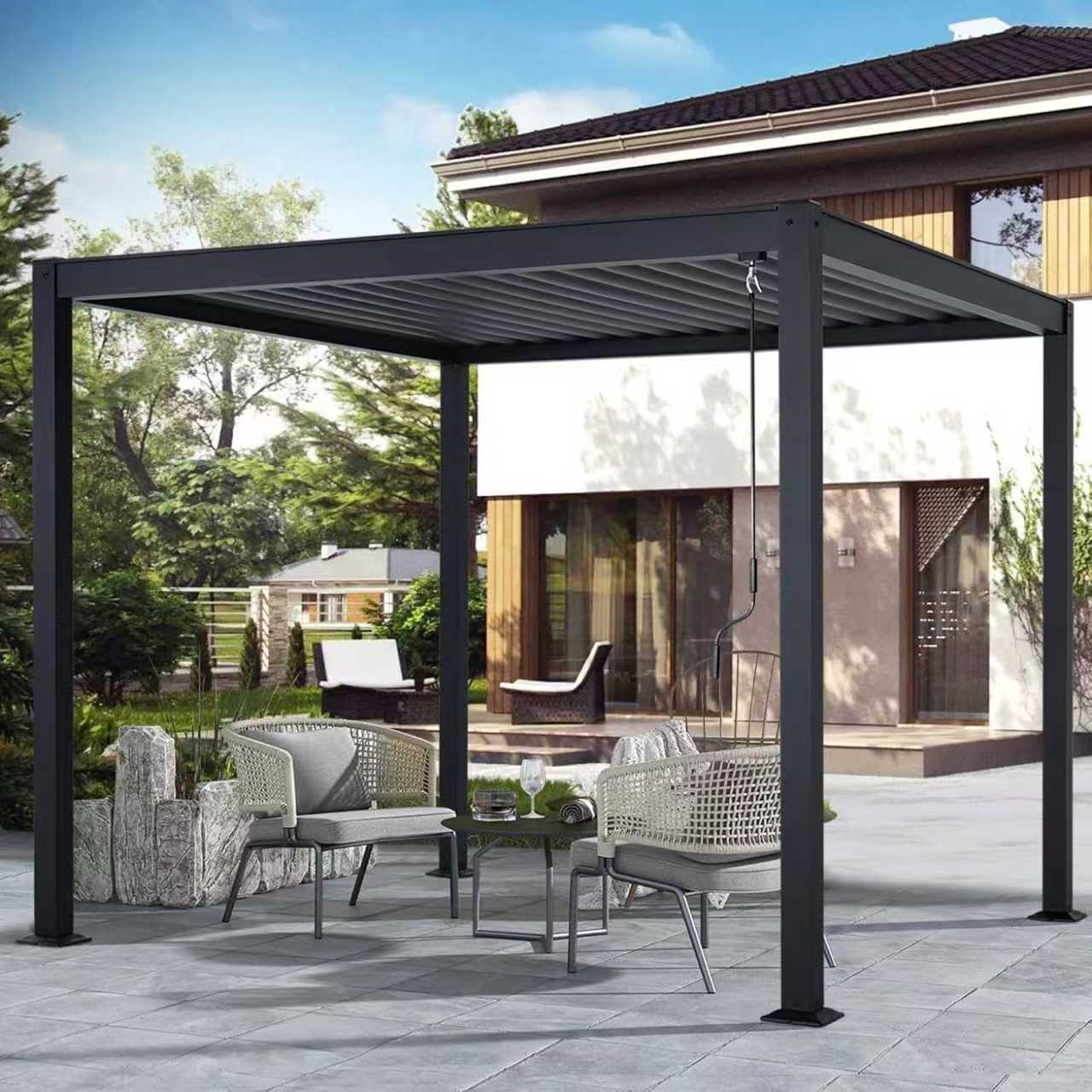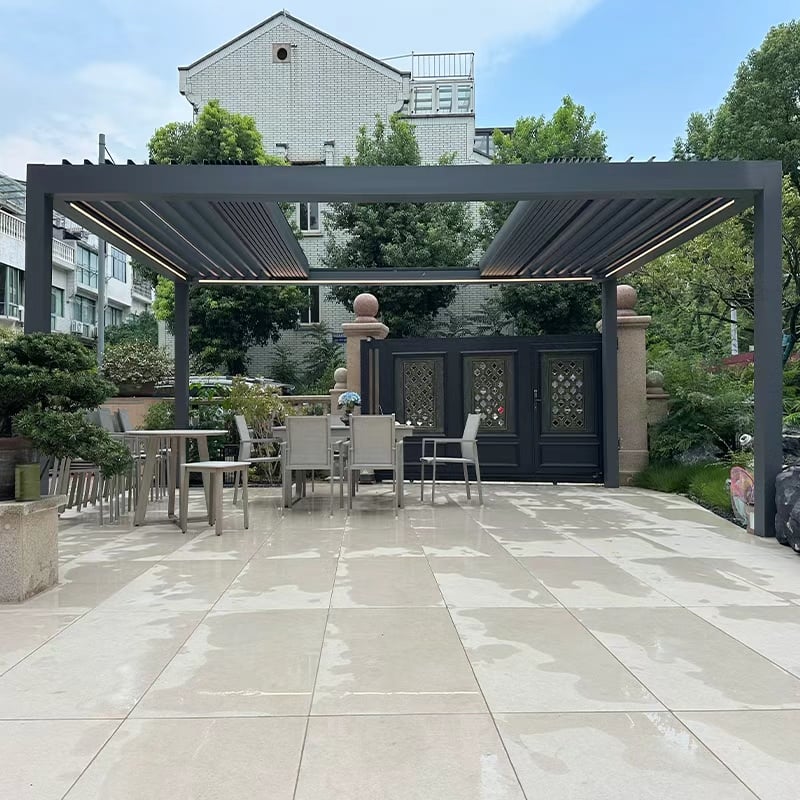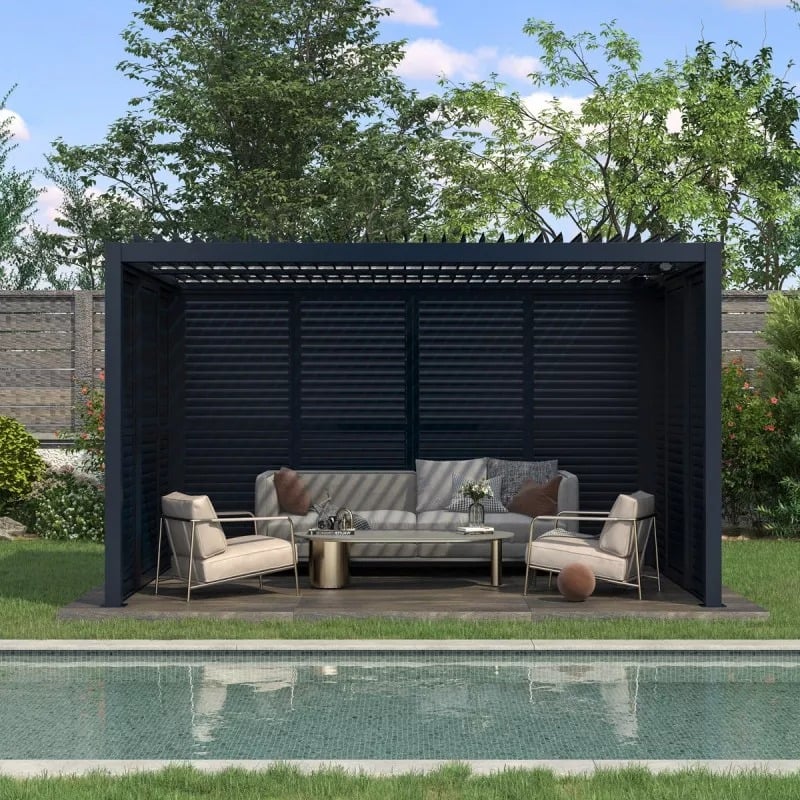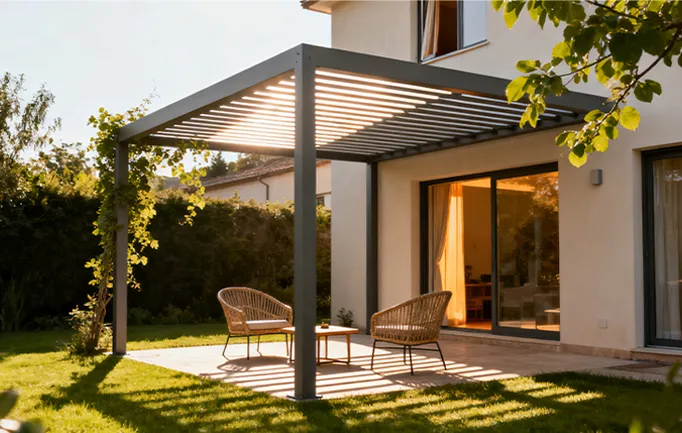
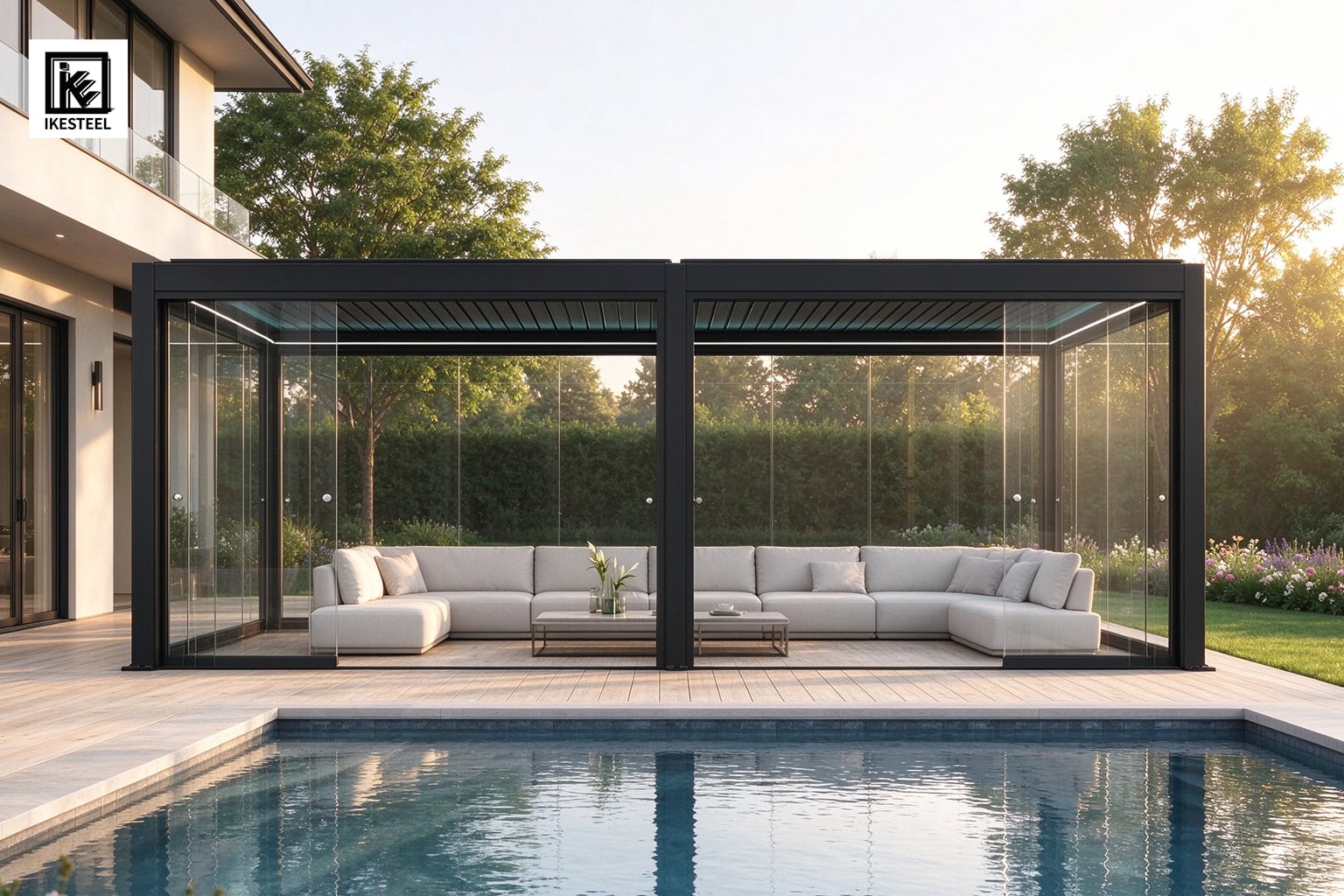
Hello everyone, I'm Gwei. Over the years I've been making aluminum pergolas, the question clients ask most isn't "How much is a pergola?" - it's "What else do I need to buy with it?" To be honest, a bare aluminum pergola frame is only half a product: it doesn't shade you completely, it can't stop wind and rain from the side, it doesn't keep insects out, and once it gets dark you can't use it at all. The part that actually works well is entirely made up of accessories. This article walks through the common outdoor accessories: what to install, what it costs, and how to avoid the traps - all in one go.
Start with the data. In 2025, the global outdoor aluminum pergola market was valued at approximately USD 2.2 to 2.5 billion, growing at around 7% annually (data from Verified Market Research and PW Consulting). More importantly, motorized louvered pergolas already account for over 60% of the market - which shows buyers stopped paying just for a frame long ago. Accessory performance is where the premium actually lives.
|
Comparison Item |
Aluminum |
Wood |
WPC |
|
Routine maintenance |
Occasional rinse |
Re-oiling every 1-2 years |
Basically none required |
|
Service life |
20+ years |
10-15 years |
15-25 years |
|
Corrosion resistance |
Rust-free; dedicated coastal coating available |
Rots and attracts wood-boring insects |
Rust-resistant, but cracks in extreme cold |
|
Accessory compatibility |
Pre-punched holes + standard tracks; easy to retrofit |
Usually requires on-site customization |
Average |
Aluminum frames offer two very practical advantages for accessory integration: the profiles come from the factory with pre-punched holes and matching tracks, so installing screens or LED strips doesn't require re-drilling; and the powder coating system is color-consistent, so accessories don't look like an afterthought bolted onto the structure.
Table 2: Common accessories and reference retail prices
|
Accessory |
What Problem It Solves |
Reference Price (USD) |
|
Motorized louvered roof |
Shade, rain protection, ventilation - all in one |
800 - 3,000+ |
|
Retractable awning / shade sail |
Low-cost shading |
30 - 500 |
|
Louvered privacy screen |
Blocks sightlines without blocking airflow |
200 - 900 per section |
|
ZIP windproof screen |
Wind protection, glare reduction, insect control |
300 - 1,200 per opening |
|
Outdoor curtains |
Enclosure feel and privacy |
30 - 80 per panel |
|
Integrated LED strip lighting |
Makes evening use possible |
100 - 600 |
|
Outdoor string lights |
Ambience on a budget |
20 - 60 per string |
|
Patio heater |
Extends the usable season |
150 - 500 |
|
Ceiling fan light |
Ventilation on muggy days |
100 - 300 |
|
Wind & rain sensor |
Automatically opens/closes the roof |
80 - 250 |
|
Gutter drainage kit |
Rainwater diversion |
100 - 400 |
|
Anchors / wall-mount brackets |
Wind safety |
50 - 300 |
The figures above are common market retail ranges. Actual pricing varies with span, motorization, and order volume.
If your budget allows, install this one - a single item that does the job of three. The blades adjust electrically from 0 to 135 degrees: fully closed at noon to block the sun, fully closed in rain to act as a roof, and fully open at dusk for airflow and a view of the sky. Check three specifications: 6063 aluminum profiles, a motor rated IP54 or higher, and a manufacturer that can provide a load calculation report. The manual crank version saves 30-40%, but for something you use every day, the motorized experience is in a different league.
The most practical side accessory. The blades are typically fixed at 45 degrees - they block your neighbor's line of sight without blocking cross-breeze. A solid wall looks more enclosed, but in reality it traps wind and accumulates heat, making the space unbearable in summer.
A small spend with an outsized effect. Choose low-voltage strips recessed into the beams - 12V or 24V, IP65 or above, dimmable, with a 2700-3000K warm white color temperature for the best evening ambience. Note that many cities have regulations on outdoor light spill, so pay attention to shielding when installing.
There is only one principle: decide on accessories before placing the pergola order. If opening dimensions, wiring routes, and drainage paths are planned at the design stage, you can save about half the cost of retrofitting later.
Don't rely on verbal promises when purchasing - ask for written documentation:
The motorized louvered roof comes first - it solves shading, rain protection, and ventilation in one product. Next, a louvered privacy screen or ZIP windproof screen. Then LED strips to enable evening use. In high-rainfall regions, don't forget gutter drainage.
In most cases, yes. Profiles from reputable manufacturers come with reserved tracks and punched holes. However, compatibility depends on the specific model's span, load capacity, and connection interfaces. Have the manufacturer confirm compatibility before ordering.
Add it up from the table above. For a residential setup with shading, privacy, and lighting, the total typically lands in the USD 500 to 1,500 range. Add a motorized louvered roof and the overall figure moves above USD 2,000.
Yes, but it must be mounted on a reinforced crossbeam using a junction box rated for ceiling fans. Confirm the beam's load capacity with the manufacturer beforehand - never hang it directly from an ordinary rafter.
A powder-coated aluminum frame lasts 20 to 30 years with low maintenance. Fabric items such as awnings and curtains depend on UV intensity, typically 5 to 10 years. Motors and LED systems usually carry 2 to 5 year warranties, and spare parts can be purchased separately.
Do the long-term math on accessories: an aluminum frame is installed once and lasts for decades, while fabrics and motors should be budgeted as consumables with a replacement cycle in mind. That is when an outdoor space genuinely pays off.
 Hot News
2026-10-20
2026-09-02
2026-07-16
2026-06-29
2026-06-30
2026-06-01
Copyright © 2026 by IKE STEEL (Luoyang) CO., LTD — Privacy Policy
 EN