 EN
EN
Superior Corrosion Resistance in Tropical Climates
How aluminum’s self-healing oxide layer withstands salt air, monsoon humidity, and constant moisture
Aluminum pergolas for shade naturally form a protective oxide layer when exposed to oxygen—a passive, self-repairing barrier that instantly reforms if scratched. This chemistry makes aluminum uniquely suited for high-corrosion tropical environments: salt spray from coastal winds cannot penetrate it; monsoon humidity does not degrade it; and constant rainfall simply beads off the surface. Unlike steel or untreated wood, aluminum requires no chemical treatments or sacrificial coatings to maintain integrity under relentless moisture exposure.
Real-world performance: ASTM B117 test data comparing aluminum, stainless steel, and treated wood in coastal tropical conditions
Accelerated corrosion testing per ASTM B117 (salt fog exposure) confirms aluminum’s real-world resilience in tropical coastal settings. After 5,000 hours of continuous salt fog exposure:
| Material | Corrosion Depth | Surface Pitting | Maintenance Frequency |
|---|---|---|---|
| Aluminum | 0.002 mm | None | None required |
| 304 Stainless | 0.12 mm | Moderate | Annual cleaning |
| Treated Wood | N/A (rot) | Severe checking | Quarterly sealing |
Aluminum retained full structural integrity with negligible corrosion. In contrast, 304 stainless steel exhibited measurable pitting—despite its chromium content—while treated wood failed through surface checking and internal rot. These results validate aluminum’s long-term reliability where other materials deteriorate rapidly.
Optimized Sun and Heat Management for Effective Shade
High solar reflectance (SRI > 75) and thermal emissivity: how aluminum pergolas for shade reduce surface temperatures by up to 30°F
Aluminum pergolas for shade mitigate heat through two complementary thermal properties: high solar reflectance and strong thermal emissivity. With Solar Reflectance Index (SRI) values exceeding 75, aluminum reflects over 75% of incoming solar radiation—significantly reducing heat absorption. Its high thermal emissivity (≥0.85) ensures any absorbed energy radiates away quickly rather than transferring downward. Field measurements across tropical zones show surface temperatures on aluminum pergolas run 25–30°F cooler than comparable wood or vinyl structures—and ambient temperatures beneath them remain up to 15°F lower than unshaded areas. This translates to a 20–30% reduction in cooling energy demand during peak sunlight hours.
Powder-coated durability: UV resistance and color retention verified in 5-year tropical exposure studies
Powder-coated aluminum pergolas resist tropical UV degradation thanks to advanced cross-linked polymer formulations. Five-year equatorial exposure studies—conducted under annual UV doses up to 2800 kJ/m² and sustained 98°F/90% RH conditions—demonstrate exceptional performance:
| Performance Metric | Result | Industry Standard |
|---|---|---|
| Color Retention | >90% ΔE <2.0 | ASTM D2244 |
| Gloss Retention | 85–92% | ASTM D523 |
| Chalking Resistance | Class 8 (None) | ASTM D4214 |
These coatings deliver zero flaking or peeling, retain hydrophobic properties after salt-spray testing, and extend service life by 40% compared to standard architectural paints—without compromising structural integrity or aesthetics.
Adaptive Louvered Systems for Intelligent Tropical Shade Control
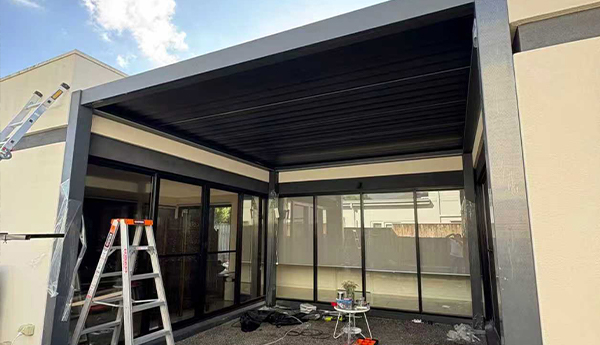
In tropical climates, weather shifts rapidly—from intense sun to torrential downpours in minutes. Motorized aluminum louvered pergolas for shade meet this challenge with intelligent, sensor-driven responsiveness. Integrated smart sensors track sun position, detect rain onset, and monitor wind speed and direction—triggering automatic louver adjustments to optimize light, airflow, and protection in real time.
Motorized Aluminum Louvered Pergolas for Shade: Real-Time Response to Sun, Rain, and Wind
Precision is built into the system: brushless DC motors enable louver positioning accurate to within one degree, allowing fine-tuned control of shade and ventilation throughout the day. When wind speeds rise, an auto-wind-avoidance function rotates slats into an aerodynamic profile—reducing structural stress and extending lifespan. At the first sign of rain, sensors initiate full closure, and high-strength aluminum blades seal tightly to shed water effectively. The result is a dynamic outdoor shelter that adapts seamlessly to tropical volatility. Independent thermal studies confirm such adaptive systems lower surrounding air temperatures by 8–12°C—enhancing comfort and usability even during extreme heat events.
Low Maintenance and Long-Term Value in High-Exposure Environments
Aluminum pergolas for shade deliver unmatched longevity and minimal upkeep in tropical settings. Unlike wood—which requires annual staining or sealing to resist rot, warping, and insect damage—aluminum never cracks, splinters, or degrades structurally. Its extruded frame and powder-coated finish withstand decades of UV exposure, monsoon rains, and salt-laden air without fading, chalking, or corrosion. Routine maintenance is limited to an occasional rinse with a garden hose to remove dust or salt residue—no solvents, sealants, or specialized cleaners needed. While initial investment may exceed that of wood, aluminum’s 30+ year service life and zero repair or replacement costs yield significantly lower total cost of ownership—making it the most economical, reliable choice for property owners in high-exposure tropical regions.
FAQs
How does aluminum perform in tropical climates compared to wood or steel?
Aluminum naturally forms a protective oxide layer that resists salt air, humidity, and rain, making it far superior to untreated wood or steel, which deteriorate rapidly under these conditions.
How effective are powder-coated aluminum pergolas in preventing UV degradation?
Powder-coated aluminum pergolas demonstrate over 90% color retention and gloss retention rates after extensive tropical UV exposure testing, ensuring long-lasting performance without fading or flaking.
Are motorized aluminum louvered pergolas energy-efficient?
Yes, the adaptive systems reduce surrounding air temperatures by up to 12°C, lowering overall cooling energy demand by 20–30% during peak sunlight hours.
What is the maintenance frequency for aluminum pergolas?
Aluminum pergolas require minimal upkeep, with occasional rinsing using a garden hose to remove dust or salt residue. No special treatments or cleaners are needed.
How long do aluminum pergolas typically last?
Aluminum pergolas are designed to last over 30 years, with negligible degradation, making them a cost-effective choice in tropical climates.
Table of Contents
- Superior Corrosion Resistance in Tropical Climates
- Optimized Sun and Heat Management for Effective Shade
- Adaptive Louvered Systems for Intelligent Tropical Shade Control
- Low Maintenance and Long-Term Value in High-Exposure Environments
-
FAQs
- How does aluminum perform in tropical climates compared to wood or steel?
- How effective are powder-coated aluminum pergolas in preventing UV degradation?
- Are motorized aluminum louvered pergolas energy-efficient?
- What is the maintenance frequency for aluminum pergolas?
- How long do aluminum pergolas typically last?